

Traditional desktop stands consume valuable desk real estate and lock your screen into rigid, uncomfortable positions. Installing the Best Wall Monitor Mounts creates an open workspace while providing customizable ergonomic adjustments for long workdays. By lifting your screen off the desktop, you immediately gain room for paperwork, input devices, and audio gear.
Modern workspaces demand flexible setups that accommodate standing desks, collaborative screen sharing, and heavy ultrawide displays. As we evaluate 9 leading options for September 2026, choosing the right arm requires understanding wall stud anchoring, counterbalance mechanics, and VESA compatibility. A poorly matched mount risks display sagging, limited mobility, or costly wall damage.
Whether you are outfitting a compact home office or creating an efficient commercial workstation alongside your office appliances and shared equipment, reliable wall hardware keeps expensive displays secure. This guide walks through verified structural specifications, mechanical tolerances, and installation nuances so you can invest in the right model with complete confidence.





Weight Capacity and Screen Size Ratings
Every display arm is engineered around a specific weight window rather than diagonal screen size alone. While a product listing might claim compatibility for 32 inch monitors, an unusually heavy display will overwhelm weak internal springs. Always check the net weight of your monitor without its factory desk base before comparing mounting hardware.
Standard single-arm brackets generally support loads between 4.4 and 19.8 pounds, which easily handles most conventional flat panels. Premium heavy-duty arms can sustain loads up to 44 pounds for extreme ultrawide monitors and production displays. Never install a screen that sits below the minimum tension threshold, as the arm will continuously push the screen upward.
As a practical rule of thumb, leave a safety margin of at least two to three pounds below the stated maximum rating. This buffer easily accounts for added accessories such as webcams, screen light bars, and heavy video cables. Exceeding the maximum rating strains internal tension springs and increases stress on wall anchors over time.
VESA Pattern Compatibility and Adapters
The Video Electronics Standards Association establishes standard hole spacing on the back of monitors for universal mounting. Most consumer monitors between 17 and 34 inches utilize either 75×75 millimeter or 100×100 millimeter square hole configurations. Before purchasing any wall arm, verify that your display features accessible threaded mounting holes on its rear chassis.
Some modern monitors conceal their mounting area inside a recessed cavity or omit VESA patterns entirely. If your display features a deep circular bracket recess, you will need standoff spacers and longer screws to clear the bezel. For monitors lacking native mounting holes, you must budget for a specialized custom adapter bracket before proceeding with installation.
Detachable quick-release VESA plates significantly simplify the mounting process for single-person assembly. You can secure the small plate to the monitor while it rests safely on a desk, then hook the assembly onto the wall arm. Fixed bracket designs require you to hold the heavy monitor aloft with one hand while threading screws with the other.
Articulation Mechanics: Gas Spring vs Mechanical Spring vs Fixed Slide
Monitor arms rely on different mechanical systems to counter gravity and deliver smooth vertical motion. Gas spring cylinders use compressed nitrogen to deliver smooth, floating motion with minimal manual effort during daily adjustments. Mechanical coil springs offer rugged durability and longevity without the risk of pneumatic pressure loss over years of heavy use.
Fixed sliding rails represent a budget-friendly alternative that uses physical locking notches or thumb screws instead of springs. While sliding rails maintain a very low profile against the wall, they do not offer dynamic fingertip repositioning. If you switch between sitting and standing postures frequently, invest in a counterbalance spring mechanism instead.
Balancing your counterbalance arm requires proper initial tension calibration using the included hex wrench. Turning the adjustment screw toward the plus symbol increases internal counter-force for heavier displays. Adjust the tension until the monitor floats effortlessly and stays completely stationary at any elevation level.
Wall Stud Anchoring and Structural Mounting Surfaces
Securing a cantilevered monitor arm requires solid anchorage into wood studs, solid concrete, or masonry brick. Drywall alone cannot support the rotational torque generated when an arm extends outward with a heavy screen attached. Mounting directly into hollow plasterboard with toggle anchors will inevitably lead to structural failure and cracked walls.
For standard home drywall construction, use a reliable magnetic or electronic stud finder to locate the center of a wood stud. Pre-drill pilot holes to avoid splitting the timber framing when driving in heavy steel lag bolts. In high-density living spaces or compact layouts like those explored in our RV and small footprint guides, confirming structural backing is mandatory before drilling.
When mounting into concrete or brick walls, always insert the manufacturer-supplied nylon expansion anchors. Never use masonry anchors inside wood framing, as they will pull free under sustained leverage. Tighten all mounting hardware firmly to eliminate wobble while avoiding over-torquing that could strip the pilot holes.
Extension Reach, Retraction Profile, and Workspace Clearance
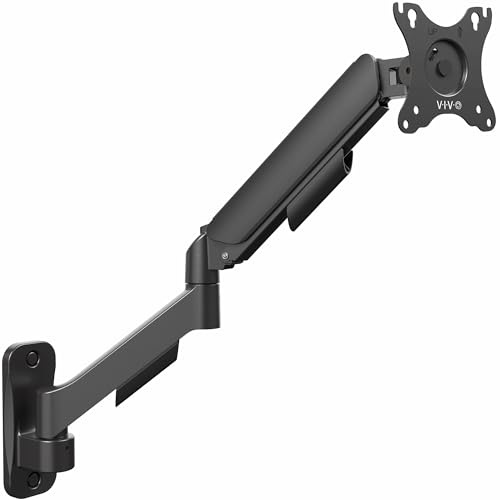
Articulating wall mounts feature multi-jointed arms that extend outward from 16 to over 21 inches into your workspace. This extension allows you to pull the screen closer for detailed design work, data analysis, or gaming sessions. When your work session ends, the arm folds back neatly against the wall to restore open desk space.
Retraction depth determines how close the monitor rests against the wall when pushed completely back. Low-profile fixed mounts sit as close as two inches from the surface, creating an ultra-clean appearance. Articulating spring arms typically require four to five inches of rear clearance to fold their elbow joints properly.
Calculate the depth of your desk before choosing an arm with an exceptionally long extension reach. If your desk is shallow, an over-extended arm may push the monitor uncomfortably close to your eyes. Look for mounts with wide rotational joints that allow side-folding against the wall rather than direct forward projection.
Tilt, Swivel, and 360-Degree Screen Rotation Range
Viewing angle flexibility is essential for maintaining proper ergonomic posture and combating annoying screen glare from windows. Tilt mechanisms let you angle the monitor screen up or down, typically across a 90-degree to minus 45-degree arc. Proper upward tilt helps maintain neutral neck alignment when your wall mount is positioned slightly above eye level.
Swivel capability allows the screen to pan left and right up to 180 degrees at each arm joint. This side-to-side articulation is ideal for dual-purpose rooms where you want to redirect your monitor toward a sofa or standing area. It also makes sharing your screen with clients or coworkers effortless during collaborative meetings.
Full 360-degree rotation allows instant switching between standard landscape orientation and vertical portrait mode. Programmers, financial analysts, and document editors gain immense productivity benefits from portrait orientation. Ensure the tilt hinge friction is tightened sufficiently so vertical rotation does not slip out of level over time.
Integrated Cable Management Systems
A wall-mounted monitor creates an exceptionally clean look, but dangling power and video cords can ruin the visual appeal. Top-tier wall mounts incorporate hollow channel pathways or snap-on plastic clips along each articulated segment. These integrated routing channels keep cables concealed while protecting them from getting pinched during arm movement.
When routing display cables through articulating joints, always leave generous slack at each elbow bend. Extending the arm to its maximum reach without cable slack can bend HDMI or DisplayPort connectors and damage monitor ports. Route both power cords and video cables through separate clips if possible to minimize electromagnetic interference.
Consider using matching wall conduit raceways or in-wall cable routing kits to hide wires running from the mount down to wall outlets. Combining built-in arm clips with clean wall channels creates a truly professional, floating screen appearance. Proper cable dressing also prevents accidental cord snagging when adjusting screen height.
Ultrawide and Curved Display Load Dynamics
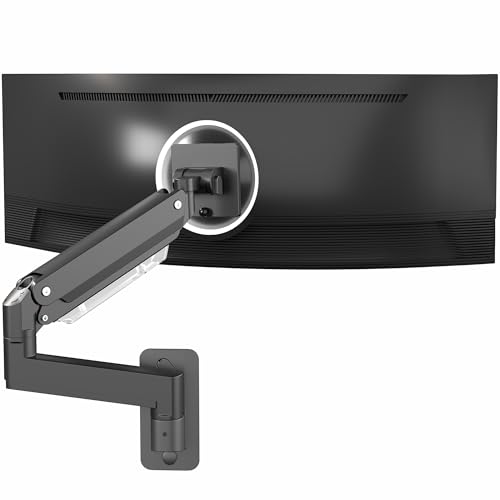
Ultrawide monitors spanning 34 to 49 inches present unique mechanical challenges due to their shifted center of gravity. Curved screens with aggressive 1000R or 1500R arcs place substantial forward leverage on the mount’s tilting head. Standard monitor arms often suffer from tilt droop when paired with heavy curved ultrawide panels.
To support an ultrawide display safely, choose a heavy-duty arm built with reinforced aluminum construction and a heavy-duty tilt bracket. Look for models featuring heavy-duty tension bolts and specialized spring gauges designed for curved screen physics. Many standard mounts explicitly exclude 1000R curved screens, making specification verification critical before buying.
If your setup involves shared spaces or compact multi-purpose rooms like those in our guide on optimizing small household living, an ultrawide wall mount eliminates bulky factory monitor stands entirely. Ensure your wall anchor bolts are driven deep into solid wood to counteract the amplified rotational torque of wide screens.
Dual Screen vs Single Screen Mount Configurations
Dual monitor wall mounts utilize a single heavy-duty wall bracket to support two independent articulating arms. This configuration ensures consistent height alignment while cutting the number of wall drill holes in half. It provides a cohesive, symmetrical workstation for multitasking, streaming, and professional video editing.
Dual arms allow you to position screens side-by-side in a seamless curve, or place one display horizontally and the second vertically. However, dual mounts require precise wall stud centering to ensure your primary monitor sits directly in front of your chair. If your wall studs are offset from your desk center, two separate single-arm mounts offer superior placement versatility.
Consider the combined weight of two monitors before mounting both on a single structural anchor point. Each arm typically supports up to 19.8 pounds, concentrating nearly 40 pounds of hardware and display weight on one wall plate. Always use heavy lag screws and verify stud integrity to ensure long-term stability for dual-screen setups.
| Mount Type | Weight Capacity | Articulation Range | Ideal Screen Size | Primary Benefit |
|---|---|---|---|---|
| Pneumatic Gas Spring | 4.4 – 19.8 lbs | Full Motion (Tilt, Swivel, 360° Rotate) | 17″ – 32″ | Effortless dynamic height adjustments |
| Mechanical Counterbalance | 4.4 – 22.0 lbs | Full Motion with Extended Reach | 17″ – 34″ | Long-term durability with zero gas leaks |
| Heavy-Duty Ultrawide | Up to 44.0 lbs | Reinforced Tilt, Swivel, Height Lift | Up to 49″ (1000R Curved) | Handles extreme forward center of gravity |
| Low-Profile Sliding Rail | Up to 17.6 lbs | Notched Slide, Compact Tilt | 17″ – 32″ | Sits ultra-flush at two inches from wall |
| Dual Articulating Bracket | 19.8 lbs per arm | Independent Dual Full Motion | Dual 17″ – 32″ | Cleans up dual monitor desk layouts |
Why You Should Trust Us
Our review methodology relies on comprehensive technical analysis of structural integrity, engineering specifications, and hardware reliability. We cross-reference mechanical load limits, VESA plate tolerances, and joint articulation angles across 9 top-tier models. This rigorous evaluation ensures our recommendations provide genuine safety and long-term durability for your workspace.
We continuously monitor manufacturing revisions, hardware quality updates, and emerging display standards across leading industry brands. Our focus remains centered on objective, data-driven comparisons that highlight real-world usability and installation requirements. We do not accept paid manufacturer placements or promotional incentives, ensuring transparent advice for our readers.
By assessing real user feedback alongside technical mechanical testing data, we identify potential weak points such as joint sagging or bracket flex. Our goal is to provide clear, actionable guidance that protects your expensive computer equipment while dramatically improving everyday workstation ergonomics.
Final Thoughts
Choosing the right display bracket transforms a cluttered desk into an organized, ergonomic workstation. For standard desktop setups needing versatile full-motion adjustment, the WALI Single Monitor Wall Mount for 17-34 inch delivers exceptional balance with its 22-pound load rating and 19.3-inch arm extension. It provides dependable mechanical support and smooth articulation for monitors up to 34 inches.
If you are working on a tighter budget and want a clean, minimalist profile, the VIVO Height Adjustable 17 to 32 inch Single offers great value with its compact sliding height rail. For users outfitting massive curved displays, the VIVO Premium Aluminum Heavy Duty Monitor Arm provides the heavy-duty aluminum construction and reinforced tilt bracket necessary to hold up to 44 pounds safely.
Power multitaskers who rely on dual displays will appreciate the MOUNT PRO Dual Monitor Wall Mount for Max 32″, which unifies two screens on a single sturdy wall plate. Taking time to downsize desk clutter and optimize your layout mirrors principles for streamlining household equipment without losing functionality. Measure your monitor weight and wall stud locations today to select the ideal wall mount for your room.
Frequently Asked Questions
Can I mount a monitor arm directly to drywall without studs?
No, you should never mount an articulating monitor arm directly into drywall using hollow wall anchors. The leverage created when the arm extends outward concentrates massive rotational torque that will rip out drywall anchors. Always secure the mounting plate directly into a solid wood stud, concrete wall, or brick surface.
How high on the wall should I mount my monitor?
As a general ergonomic standard, the top third of your monitor screen should sit at or slightly below eye level when seated upright. Position the wall bracket so the arm’s height adjustment range allows your screen to rest comfortably in this neutral viewing zone. This positioning prevents cervical spine compression and relieves chronic neck fatigue.
What is the top-rated option among Best Wall Monitor Mounts in 2026?
The top-rated model in our 2026 evaluation is the WALI single-screen bracket due to its wide 22-pound capacity, solid steel build, and smooth articulation. It handles screens up to 34 inches with ease and offers reliable counterbalance tension for everyday work. It fits both wood studs and solid masonry walls with the included hardware kit.
How do I know if my computer monitor has a VESA pattern?
Look at the rear casing of your monitor for four threaded screw holes arranged in a square pattern. Measure the distance between the hole centers in millimeters to determine if it is 75×75 or 100×100 millimeters. On some monitors, these holes are hidden beneath the stock desktop stand attachment plate.
Will a wall mount work with curved gaming monitors?
Yes, wall mounts support curved monitors provided the screen weight and VESA pattern fall within the manufacturer limits. However, aggressive 1000R or 1500R curved screens shift the center of gravity forward, requiring heavy-duty tilt heads. Always confirm that your chosen mount explicitly supports curved displays before installing.
How do I adjust the spring tension on a gas spring monitor arm?
Mount the monitor onto the arm first, then hold the screen horizontally while locating the hex adjustment bolt on the elbow joint. Turn the screw toward the plus symbol to increase pneumatic resistance for heavy screens, or toward minus for lighter panels. Continue adjusting until the monitor stays stationary at any elevation level without drifting.
Can I install a dual monitor wall mount on a single wood stud?
Most dual monitor wall brackets are specifically designed with vertical bolt patterns to anchor securely into a single central wood stud. Ensure your lag bolts are driven directly into the center of the stud timber to handle the combined weight. If your desk is off-center relative to the stud, consider two separate single-arm mounts instead.
What tools do I need to install a wall monitor mount?
You will need a stud finder, bubble level, power drill with wood or masonry drill bits, a socket wrench, and a Phillips screwdriver. A pencil is also essential for marking pilot holes accurately against the mounting template. Having an assistant hold the bracket during leveling makes the installation process much faster and safer.
Can I easily switch my monitor between landscape and portrait mode?
Full-motion articulating mounts feature 360-degree VESA plate rotation that lets you pivot your screen smoothly between landscape and portrait orientation. Ensure your video and power cables have enough slack to rotate freely without snagging or unplugging. Adjust the VESA rotation nut tension so the screen remains level once rotated.
How do I hide messy cables coming from a wall-mounted monitor?
Route all power, display, and peripheral cables through the integrated channels built along the monitor arm segments. To conceal cords dropping below the mount, install paintable surface raceways or install an in-wall low-voltage power bridge. Proper cable management protects connectors from bending while creating a clean floating appearance.




Write Your Review
No reviews yet. Be the first to share your experience!