
Quick Answer: The Best Air Scrubbers match rated airflow to a contained work area, use a staged filter path that protects the final HEPA filter, and provide practical access to replacement filters. A 500-550 CFM stackable unit suits many room-scale renovation and restoration tasks; a 1,000 CFM wheeled machine can move more air in a larger enclosure but brings more noise, power demand, and draft. Activated carbon targets some odors and gases, while HEPA media targets particles. Neither replaces source control, containment, PPE, or professional remediation for regulated hazards. Amazon data was collected through Crawlbase, and we did not perform hands-on airflow, leakage, particle, sound, power, or filter tests. Check Price on Amazon →
The Best Air Scrubbers are job-site filtration machines rather than ordinary room fans. They pull dirty air through one or more filters and discharge cleaner air back into the space or through ducting. When the exhaust is routed outside a sealed work zone, the same machine may help create negative pressure so dust is less likely to escape into adjacent rooms.
Rated CFM is only a starting point. Filter loading, duct length, bends, leaks, and the resistance of carbon and HEPA media reduce real airflow. A smaller machine with a well-sealed housing, fresh filters, and correct containment can be more useful than a high-CFM machine running through clogged filters. Buyers should compare the entire operating system, not just the largest number in a title.
Top Picks at a Glance
These Best Air Scrubbers selections represent 500-550 CFM stackable machines, 1,000 CFM high-capacity options, three-stage filter systems, adjustable airflow, daisy-chain or outlet features, and wheeled portability. All specifications below are Amazon listing claims collected through Crawlbase and require confirmation in the current manual.
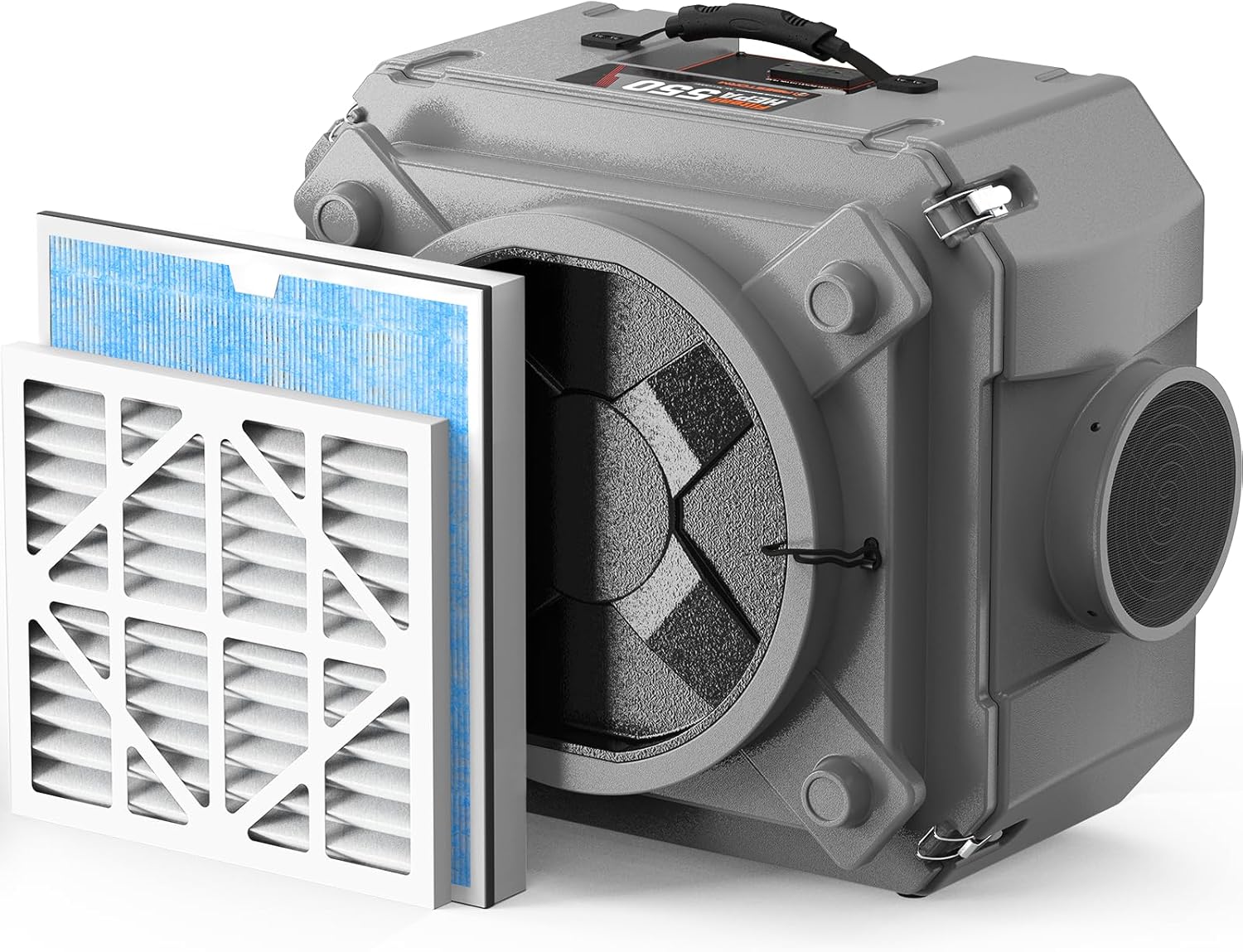
- Best Overall 550 CFM Route: VEVOR 550 CFM Three-Stage Air Scrubber. The listing describes a stackable negative-air machine with MERV-10, carbon, and H13 HEPA stages for home, industrial, and commercial use.
- Best Established Stackable Alternative: ALORAIR Clean Shield Hepa 550. The title names three-stage filtration, a MERV-10 filter, HEPA, activated carbon, and heavy-duty commercial use.
- Best Restoration-Focused 550 CFM Option: BlueDri Air Shield 550 HEPA Air Scrubber. It is listed for water-damage restoration, up to 1,400 square feet, and daisy-chain capability.
- Best Compact Roto-Molded 500 CFM Option: MOUNTO HEPA500 Commercial Air Scrubber. The listing names a 500 CFM negative-air machine and roto-molded housing.
- Best GFCI-Connection Route: Abestorm HEPA 550 Air Scrubber. Its title includes three-stage filtration, GFCI connection, MERV-10, HEPA, and activated-carbon wording.
- Best High-Capacity Two-Stage Unit: BlueDri AS1000 1,000 CFM Portable Air Scrubber. A larger airflow class suits bigger containment areas when electrical, noise, and exhaust planning support it.
- Best Adjustable-Airflow Three-Stage Option: SereneLife Commercial HEPA Air Scrubber. The listing names MERV-10, carbon, HEPA, portable construction, dust and odor removal wording, and adjustable airflow.
- Best Outlet-Equipped Restoration Route: XPOWER X-3400A Three-Stage Air Scrubber. The title includes negative-air operation and power outlets for restoration and home use.
- Best Wheeled 1,000 CFM Route: MOUNTO Portable Industrial Negative-Air Scrubber. The listing names a 1 HP motor, True HEPA wording, two speeds, handle, wheels, and a warranty. Check the shortcode ASIN for the current configuration.




Air Scrubber, Air Purifier, Fan, or Negative-Air Machine?
A household air purifier is generally designed for occupied-room comfort, lower sound, and long-term filtration. An air scrubber is typically built for higher dust loads, portable job-site use, replaceable prefilters, ducting, and containment work. A fan or air mover circulates air but does not capture particles unless paired with a filter system designed for its airflow.
“Negative-air machine” describes how the scrubber is configured. If filtered exhaust is ducted out of a reasonably sealed work zone, the zone can operate at lower pressure than surrounding areas. Air then tends to enter through controlled gaps instead of pushing dust outward. The Best Air Scrubbers support this setup with suitable duct collars and sealed filter paths, but the machine alone cannot create effective containment when doors, walls, and exhaust routes leak badly.
Do not confuse negative pressure with a vacuum on the room. The goal is a controlled pressure relationship and directional airflow. Professionals may use pressure monitors, smoke visualization, and documented air-change targets. For mold, asbestos, lead, sewage, fire residues, or other regulated contaminants, follow local rules and qualified remediation guidance.
Use CFM and Air Changes per Hour Carefully
CFM means cubic feet per minute. A simple theoretical air-change estimate multiplies room volume in cubic feet by the desired air changes per hour, then divides by 60. For example, a 20 x 15 x 8-foot enclosure contains 2,400 cubic feet. Six theoretical air changes per hour would require 240 CFM before accounting for filter loading, duct loss, leakage, and safety factors.
The Best Air Scrubbers provide enough rated airflow to meet the project plan after those losses. Do not use the calculation as a universal health guarantee. Required air changes depend on the contaminant, work process, containment quality, occupancy, and professional standard. A machine advertised at 550 CFM may deliver less once filters load or a long exhaust duct is attached.
More CFM is not always better. Excessive airflow can pull plastic containment inward, create door pressure, spread loose debris near the intake, or make the space uncomfortable. A 1,000 CFM machine makes sense when a larger area and electrical circuit can support it. Adjustable airflow or two-speed controls make balancing easier.
Understand the Filter Stages
Prefilter or MERV stage
The first stage captures larger dust, fibers, and debris before they reach the expensive final filter. MERV-10 wording appears in several selected titles. Inspect this stage frequently during sanding, demolition, or drywall work because a loaded prefilter increases resistance and reduces airflow.
Activated carbon
Carbon media adsorbs some odors and gaseous compounds. It does not replace particle filtration, and its useful life can be shorter in a heavily odorous environment. A thin carbon sheet and a deep carbon bed have different capacity even when both titles say “activated carbon.” Confirm replacement type, weight, and change guidance.
HEPA stage
A final HEPA filter targets fine particles after larger debris is removed. H13 or True HEPA wording can be useful, but media efficiency is only part of performance. Air bypass around the filter, damaged gaskets, a warped door, or incorrect installation can reduce system capture. The Best HEPA Air Scrubbers guide goes deeper into final-filter and seal considerations.
The Best Air Scrubbers make filter access straightforward without encouraging dirty-side dust to spill into the clean side. Turn the unit off and follow PPE and containment procedures before opening it. Bag contaminated filters according to project requirements. Never shake a loaded filter indoors to extend its life.
Plan Replacement Filters Before Buying
Check the exact prefilter, carbon filter, and HEPA part numbers. Confirm availability from more than one seller when possible and calculate the cost per project or operating month. A low purchase price can become expensive if the final filter is proprietary, difficult to source, or replaced prematurely because the prefilter is undersized.
Use an hour meter, pressure indicator, visual inspection, or the manufacturer’s schedule as directed. Time alone cannot predict loading: one hour of drywall sanding can load a filter more than many hours of light odor control. A sudden airflow drop, unusual noise, damaged media, or visible bypass needs investigation.
Keep spare prefilters in clean, dry packaging on a job site. Store HEPA filters where corners and gaskets cannot be crushed. Write installation dates on removable labels if the procedure permits. The Best Air Scrubbers have a clear consumables plan before the first dirty-air cycle begins.
For the Best Air Scrubbers, filter availability is part of performance because a machine cannot maintain its intended airflow or capture with unavailable, damaged, or improvised media.
Portability, Controls, Power, and Noise
Stackable 500-550 CFM machines can be easier to carry up stairs and arrange in a tight containment zone. Inspect handle placement, housing strength, cord storage, and whether stacked operation is explicitly allowed. A 1,000 CFM unit with wheels reduces rolling effort on smooth floors but still needs safe lifting over thresholds and stairs.
Daisy-chain or auxiliary outlets can reduce cord clutter when the manual allows multiple units, but every connection must stay within the circuit, device, and GFCI ratings. Do not assume that a built-in outlet permits unlimited machines. High-current equipment, dehumidifiers, heaters, and air movers may need separate circuits. The Best Dehumidifiers for Water Damage guide covers moisture removal, which is a separate process from particle filtration.
Noise matters in occupied buildings and long projects. Amazon titles rarely give enough information about sound at each speed and filter condition. Place the machine where the intake remains effective without creating a trip hazard, and use ducting or barriers only as the manual allows. Do not cover the housing to reduce sound.
Safe Setup and Source Control
Remove or capture dust at the source whenever possible. Tool-mounted extraction and a suitable Best Shop Vacuums setup can reduce the material that reaches room air. Wet methods, enclosed work, and careful debris handling may also be part of the control plan. An air scrubber is a backup layer, not permission to create uncontrolled dust.
Position the intake to pull contaminated air across the work zone without blowing dust from the floor. Keep the discharge from short-circuiting directly back into the intake. Seal duct connections, protect exhaust openings from weather and pests, and avoid discharging where people can be exposed. Check that the machine is upright and all filter doors are latched.
The Best Air Scrubbers are operated according to a written containment and cleanup plan. That plan should address electrical safety, PPE, filter handling, pressure checks, surface cleaning, and final verification. Do not claim a space is safe based only on elapsed runtime or the absence of visible dust.
How We Tested and Evaluated
We evaluated the Best Air Scrubbers through commercial-intent research and Amazon listing data collected with Crawlbase. The selection covers rated 500, 550, and 1,000 CFM classes; two- and three-stage filtration; MERV-10, carbon, HEPA, and H13 wording; stackable and wheeled housings; adjustable or two-speed airflow; GFCI, daisy-chain, and outlet features; and restoration-oriented use.
We did not perform hands-on CFM, air-change, leakage, pressure, HEPA efficiency, carbon-capacity, particle-count, sound, power-draw, duct-loss, GFCI, filter-life, housing, or durability tests. Coverage areas, H13, True HEPA, ozone-free, industrial, commercial, heavy-duty, and odor-removal wording remain listing claims. Buyers should confirm certifications, manuals, replacement filters, and professional requirements for the intended hazard.
Common Mistakes
Even the Best Air Scrubbers underperform when the filter path, enclosure, or maintenance plan is weak. Avoid these mistakes:
- Buying on CFM alone. Account for room volume, target air changes, filter loading, duct loss, and containment leakage.
- Skipping the prefilter. Large dust can load the HEPA stage quickly and reduce airflow.
- Expecting carbon to capture particles. Carbon and HEPA address different contaminant categories.
- Calling ordinary recirculation negative air. Negative pressure requires a controlled enclosure and exhaust path.
- Overloading outlets or circuits. Follow the unit, cord, GFCI, and site electrical ratings.
- Placing intake and exhaust together. Short-circuiting recleans the same air while leaving dead zones.
- Handling dirty filters in an occupied area. Follow PPE, bagging, and disposal procedures.
- Using the scrubber instead of source control. Capture dust at the tool and clean settled debris.
Buying Checklist
Use this checklist when comparing the Best Air Scrubbers:
- Calculate room or containment volume and identify the project-specific air-change requirement.
- Compare rated airflow at each speed and expect losses from loaded filters and ducts.
- Confirm prefilter, carbon, and HEPA stages plus replacement part numbers.
- Inspect filter gaskets, latches, housing seams, and duct-collar design.
- Choose stackable handles or wheels according to stairs, thresholds, and storage.
- Review sound, speed control, hour meter, indicator, and shutdown controls.
- Verify voltage, current, GFCI, outlet, daisy-chain, cord, and circuit requirements.
- Plan intake, exhaust, negative-pressure checks, and safe filter changes.
- Confirm professional and regulatory requirements for the actual contaminant.
Frequently Asked Questions
What is the difference between an air scrubber and an air purifier?
An air purifier usually emphasizes quieter long-term use in occupied rooms. An air scrubber is commonly built for higher dust loads, portable restoration work, replaceable prefilters, ducting, and containment. Product categories overlap, so compare housing, filters, airflow, and intended duty.
How many CFM do I need?
Start with room volume and the air changes per hour required by the project plan, then account for filters, ducts, leakage, and safety factors. Do not select a universal CFM value for every contaminant or enclosure.
Do the Best Air Scrubbers remove mold?
HEPA filtration can capture airborne particles, including some spores, but a scrubber does not remove wet or contaminated building materials, repair moisture, or prove remediation is complete. Mold work requires source removal, moisture control, containment, cleaning, and appropriate professional guidance.
Can I use an air scrubber for smoke odors?
HEPA media addresses particles, while activated carbon may adsorb some odor compounds. Capacity depends on carbon quantity, airflow, humidity, and contaminant load. Source cleanup and replacement of damaged materials may still be necessary.
Can two air scrubbers be daisy-chained?
Only when the manual allows it and the total electrical load remains within every outlet, cord, GFCI, and circuit rating. A daisy-chain feature is not unlimited power. Have site electrical conditions evaluated when uncertain.
How often should filters be changed?
Follow the manufacturer and project procedure. Prefilters may need frequent changes during heavy dust, while final HEPA life depends on loading, seal condition, and pressure or airflow indicators. Replace damaged or contaminated filters immediately according to safe handling rules.
Can I sleep in a room with an air scrubber running?
Do not assume that filtration makes an active work zone suitable for occupancy. Noise, electrical cords, exhaust configuration, contaminant type, and professional containment rules all matter. Follow the project plan and keep occupants out when required.
How do the Best Air Scrubbers support negative pressure?
They pull air from a contained zone and can send filtered exhaust outside through approved ducting. Effective negative pressure still depends on enclosure leakage, makeup-air paths, exhaust placement, and verification with the appropriate monitoring method.
Bottom Line
The Best Air Scrubbers combine appropriate airflow, a sealed staged-filter path, obtainable replacement media, and controls that suit the job site. A 550 CFM stackable unit offers portable room-scale flexibility, while a 1,000 CFM wheeled machine can serve larger enclosures when noise, power, and ducting are managed.
Calculate the containment volume, protect the HEPA stage with timely prefilter changes, separate particle capture from odor adsorption, and verify negative pressure instead of assuming it. Most importantly, use filtration alongside source control, safe cleanup, PPE, and professional guidance for regulated or hazardous materials.